

By using this site, you agree to the Privacy Policy and Terms of Use.
Accept
Felly ViralFelly ViralFelly Viral
Notification Show More
Font ResizerAa
  • Home
  • Technology
    TechnologyShow More
    Traditional firewalls can’t see what’s inside an AI prompt. Check Point built one that can.
    September 10, 2026
    The Trump phone just got a $250 price hike
    September 10, 2026
    Anthropic scanned 481 million transcripts to find four models that reached the open internet
    September 10, 2026
    Nintendo’s latest Switch 2 update adds VRR support in TV mode
    September 10, 2026
    Instagram’s head says engagement falls by half without the algorithm
    September 10, 2026
  • Sports
  • World News
    World NewsShow More
    ‘Gone in a blink’: Nepal floods sweep away Indian workers who built hotels
    September 10, 2026
    Russian attacks kill 7 in Ukraine as Kyiv targets gas plants deep in Arctic
    September 10, 2026
    Israeli attacks kill at least four Palestinians in northern Gaza
    September 10, 2026
    Anthropic discloses 4th AI hacking incident as researcher quits over safety
    September 10, 2026
    Fighting escalates in Yemen; Houthi attacks trigger alerts in Saudi Arabia
    September 10, 2026
  • Politics
    PoliticsShow More
    Houthis, Yemeni forces engaged in fierce battles: Why each front matters
    September 10, 2026
    China rejects the US distillation advisory as unfounded accusations and smears
    September 10, 2026
    Tourists in England face nightly levy on hotel and Airbnb stays under new plans
    September 10, 2026
    Huawei’s US racketeering trial opens with prosecutors calling it a criminal enterprise
    September 10, 2026
    Trump pledges $5,000 to every American if Republicans win November elections
    September 10, 2026
  • Science
  • Entertainment
    EntertainmentShow More
    Hollywood Shifts Strategy as Cross-Studio Streaming Bundles and Expanded Theatrical Windows Take Hold
    September 10, 2026
    Suno releases its first AI music model made with record industry help
    September 9, 2026
    Covenant leaves stealth with Anthem and factories in three countries
    September 9, 2026
    Alex Gibney’s Musk documentary premieres in Venice with an AI-simulated interview
    September 9, 2026
    Doyle: Waardah the one to beat in the Park Hill
    September 9, 2026
  • Contact
Reading: The Justice Department is investigating whether Nvidia structured its Groq deal to avoid antitrust review
Share
Font ResizerAa
Felly ViralFelly Viral
  • Entertainment
  • Science
  • Technology
Search
  • Home
    • Home News
    • Home 2
    • Home 3
    • Home 4
    • Home 5
  • Categories
    • Technology
    • Entertainment
    • Science
    • Health
  • Bookmarks
    • Customize Interests
    • My Bookmarks
  • More Foxiz
    • Blog Index
    • Sitemap
Have an existing account? Sign In
Follow US
Felly Viral > Blog > Business > The Justice Department is investigating whether Nvidia structured its Groq deal to avoid antitrust review
Business

The Justice Department is investigating whether Nvidia structured its Groq deal to avoid antitrust review

admin
Last updated: September 10, 2026 7:26 am
admin Published September 10, 2026
Share
SHARE
September 10, 2026 at 7:26 amIn: Business

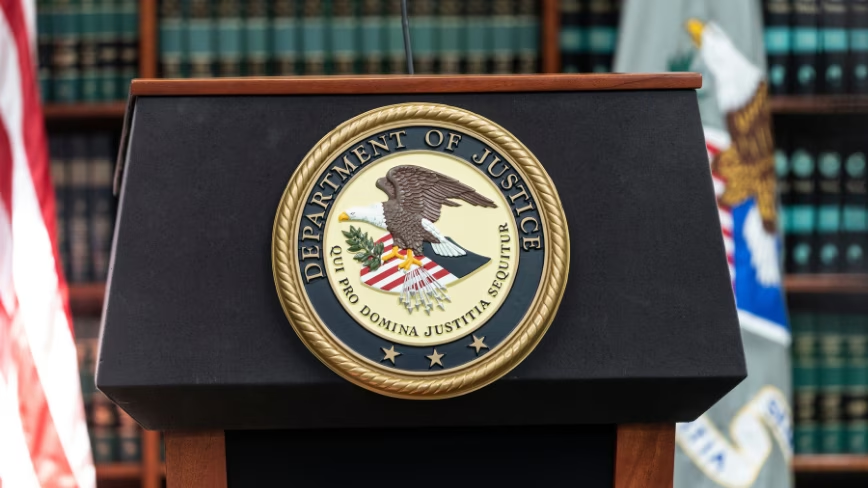
Seal of Justice Department Credit: lev radin via Shutterstock.com The US Justice Department is examining whether Nvidia deliberately structured its licensing deal with inference chip designer Groq in a way that avoided antitrust review, according to a New York Times report. The Justice Department opened its inquiry shortly after the deal was announced in December and has since sent Nvidia a formal request for information. If investigators find wrongdoing, they could seek fines, although forcing Nvidia to unwind the deal is considered unlikely. The structure of the deal is what matters in this case.

Nvidia took a non-exclusive licence to Groq’s chip technology and hired several of its executives, including founder Jonathan Ross, but it did not buy the company. A merger has to be reported to regulators and can be blocked. A technology licence followed by a round of hiring looks, at least on paper, like two normal business decisions. “The Groq story is a prime example of the American system working as designed to promote innovation, reward entrepreneurs, and benefit consumers,” an Nvidia spokesperson said. That defends the result, but it does not really answer the question at the centre of the investigation: whether the structure itself was designed to avoid scrutiny.

That may be difficult for regulators to prove as the antitrust law generally focuses on whether control of a company has changed hands, and a non-exclusive licence does not transfer control. To make the case against Nvidia, enforcers would have to argue that the arrangement functioned as a merger, even though it was not one on paper. The Nvidia answer is straightforward, as the licence is non-exclusive, Groq still exists, and its engineers are free to move to another company. All of that can be true while Groq is no longer in a position to compete as it did before.

That distinction is likely to be central to the investigation. What makes the case more interesting is that Groq is not the only example. Nvidia used a similar structure with Poolside, paying $6bn to license its model factory and hiring 109 staff. Once the same pattern appears more than once, it becomes harder to treat each deal as an isolated commercial decision.

For antitrust regulators, that pattern may matter more than any single transaction. Reuters, following the NYT, puts the Groq arrangement at $17bn, and we have reported $20bn. The difference may come from whether the figure refers only to the licence payment or includes the value of the hiring arrangement, but that has not been established here. The copy should therefore avoid putting a number on the deal until the figures are reconciled.

Whatever the final figure, the effect on Groq is clearer. It had become one of the most credible independent challengers in inference silicon, after raising money at a $3.5bn valuation in a round that Nvidia itself joined. After the deal, Groq lost its founder and senior engineers. It has since been raising $650mn to rebuild around the team and business that remain.

So while Nvidia did not acquire Groq outright, it took its technology and many of the people behind it. That leaves regulators with a question that is harder to answer than a simple merger review: when does a licence and a hiring spree amount to buying a competitor without actually buying the company? Congress had already raised concerns about the arrangement. Senators Elizabeth Warren and Richard Blumenthal questioned the deal in March.

Nvidia is also in talks with Korean inference chipmaker Rebellions, which operates in the same market but outside the reach of US merger review. The wider significance is that Nvidia now sits at the centre of many of the AI industry’s biggest compute deals. If the Justice Department decides that this kind of licence-and-hire arrangement was used to get around antitrust scrutiny, the consequences could extend well beyond Groq. Other companies could start using the same structure, particularly if it becomes clear that a dominant supplier can absorb a challenger without formally acquiring it.

For Europe, that may be the more important part of the story. The EU has spent the past two years developing new tools to scrutinise acquisitions of promising companies, including a referral mechanism for deals that fall below standard notification thresholds. But a technology licence followed by a recruitment drive does not obviously fall into that category, because neither action on its own amounts to a concentration. If the US investigation concludes that Nvidia’s structure was a way around merger rules rather than simply a different way of doing business, European regulators may have to ask whether their own rules leave a similar gap.

You Might Also Like

Sapporo to move some beer production from Canada to US after tariffs

AI cancer cures slowed by chip shortage, says UK's biggest tech boss

Firmus Energy customers face price increase

The one thing you need to do to succeed – according to top bosses

The average American PC now costs more than $1,000

Share This Article
Facebook Twitter Email Print
Leave a comment

Leave a Reply Cancel reply

Your email address will not be published. Required fields are marked *

What's Hot

Badenoch accuses Burnham of kicking defence spending into the long grass

Zack Polanski says he'll run for former PM Starmer's seat in by-election

How significant is the Yemeni government’s military gains against Houthis?

Aviation faces hotter, stormier skies – and passengers might have to accept more disruption

‘Rhetoric differs’: How the UK’s relationship with Israel took a downturn

Cathay Pacific and Google partner on AI contrail avoidance for ultra-long-haul flights

Categories

Business

69 Articles

Politics

254 Articles
- Advertisement -
Ad image

Categories

  • ES Money
  • U.K News
  • The Escapist
  • Insider
  • Science
  • Technology
  • LifeStyle
  • Marketing

About US

We influence 20 million users and is the number one business and technology news network on the planet.

Subscribe US

Subscribe to our newsletter to get our newest articles instantly!

© Foxiz News Network. Ruby Design Company. All Rights Reserved.

Powered by
►
Necessary cookies enable essential site features like secure log-ins and consent preference adjustments. They do not store personal data.
None
►
Functional cookies support features like content sharing on social media, collecting feedback, and enabling third-party tools.
None
►
Analytical cookies track visitor interactions, providing insights on metrics like visitor count, bounce rate, and traffic sources.
None
►
Advertisement cookies deliver personalized ads based on your previous visits and analyze the effectiveness of ad campaigns.
None
►
Unclassified cookies are cookies that we are in the process of classifying, together with the providers of individual cookies.
None
Powered by
Welcome Back!

Sign in to your account
