



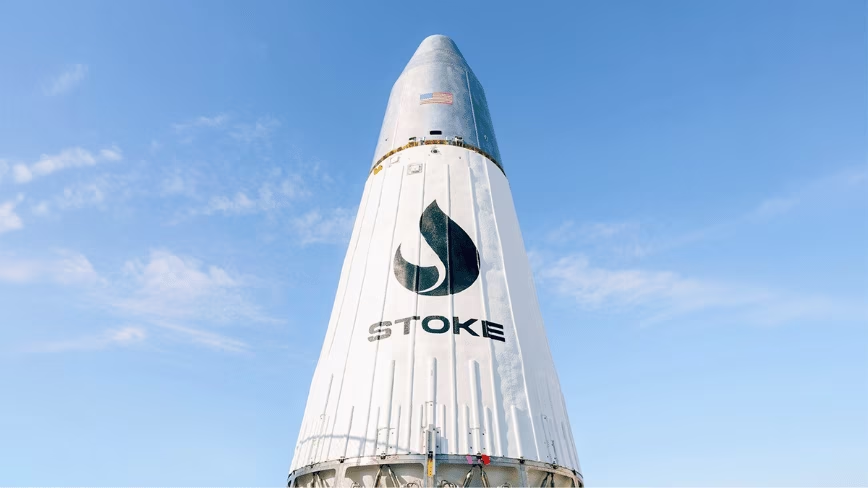

The upper stage flight article for Flight 1 of Stoke Space’s Nova Pathfinder, at the company’s headquarters in Kent, Washington. Credit: Stoke Space Stoke Space has raised a billion dollars for a rocket that has never flown. The Washington company says the Series E takes its total funding to $2.3bn. It has not yet reached orbit once.
Point72 Ventures and Spark Capital co-led the round, according to Stoke’s announcement. General Innovation, Glade Brook Capital, US Innovation Technology, Washington Harbour Partners, Woven Capital and Y Combinator also took part. Stoke did not disclose a valuation. Read the announcement carefully and it says something slightly narrower than the headline.
Stoke has “completed an initial closing of its billion-dollar Series E”. The round is sized at a billion, then, but not necessarily all in the bank. The company has not said how much of it has closed. The investor list is worth a second look too.
Y Combinator is in it, which is unusual company for a rocket manufacturer at Series E. It also points at how early some of this money went in. Point72 Ventures says it has backed Stoke through several stages already. What the money is actually for Stoke is building Nova, a launch vehicle designed to be fully reusable.
Both stages come back, refly, and do it quickly. That last part is the difficult bit and the reason the round is this size. Falcon 9 recovers its booster and throws away the upper stage every flight. Full reuse means recovering the stage that actually goes to orbit, which has to survive re-entry from orbital velocity.
SpaceX is attempting it with Starship and has not finished the job. The near-term vehicle is Nova Pathfinder, which Stoke says is approaching its first flight. It will carry payloads while proving the architecture. The company is targeting early 2027 for that first orbital launch.
Behind it sits a bigger vehicle. Nova Block 2 is designed to put 15 metric tons into low Earth orbit inside a five-metre fairing. Stoke is aiming for a first launch in 2029. The company frames that second vehicle as a response to customers rather than an engineering ambition.
Operators have spent several years asking for more capacity, better availability and room for larger missions, Stoke says. Block 2 is its answer. The money pays for the factories, test stands, launch sites and recovery infrastructure that a high-cadence operation needs, not just the vehicles. Two dates, no flights Both of those dates deserve the scepticism that launch schedules have earned.
Stoke was founded seven years ago and is still ahead of its first orbital attempt. A 2029 target for a second, larger vehicle is a statement of intent. It is not a plan a customer can book against. Andy Lapsa, Stoke’s co-founder and chief executive, made the underlying argument in the announcement. “Every mature transportation system is built around fully reusable vehicles,” he said. “It’s the only way to reach the cost floor while scaling availability.” That is a reasonable thesis and it is also unproven at orbital scale by anyone.
Clay Fisher of Spark Capital called full reusability “the inevitable end state of the market”. Inevitable is doing a lot of work in a sentence about a vehicle that has not launched. Why investors keep writing these cheques The demand side is not speculative, which is what makes the bet legible. Launch capacity is genuinely short, and the companies that need it are raising money on the assumption it will appear.
Starcloud raised $250mn in August for orbital data centres it cannot yet book rides for. Pixxel closed India’s largest space round yesterday. Rocket Lab spent $8bn buying Iridium in June to own a constellation rather than just launch other people’s. Meanwhile the incumbent keeps getting further ahead.
SpaceX is planning a $100bn spaceport in Louisiana built for thousands of launches a year. Anyone funding a competitor is betting on one thing: that a single provider at that scale is a problem the market will pay to solve. The European comparison is unflattering Stoke has raised $2.3bn without flying. Two days ago Isar Aerospace reached orbit on its second flight.
It was the first European commercial launcher to manage it, on a fraction of that capital. The comparison is not entirely fair, because Isar is not attempting full reuse and Stoke is. Ambition costs money. But it does illustrate what American launch companies can raise on a promise and European ones cannot.
That gap sits behind every conversation about European sovereign launch. It also shows where the risk sits. Isar has a flight record and a smaller balance sheet. Stoke has the opposite.
The government thread One detail in the announcement is worth pulling out. Its technology development has drawn support from NASA, the US Space Force, the Defense Innovation Unit and the National Science Foundation, Stoke says. None of those agencies is a passive observer. Between them they fund early technology, buy launches, and decide who may bid for national security work.
That is a slower and more reliable form of support than a venture round. That matters for how you read the round. American launch startups are not purely commercial bets. They are partly instruments of a policy to avoid depending on one company for access to orbit, and that policy has been funding alternatives for years before private capital arrives.
Whether Stoke becomes the second fully reusable launch provider or an expensive lesson in why the first one took twenty years, the answer starts arriving in early 2027. Until then, $2.3bn is riding on a vehicle nobody has watched leave the ground.


