



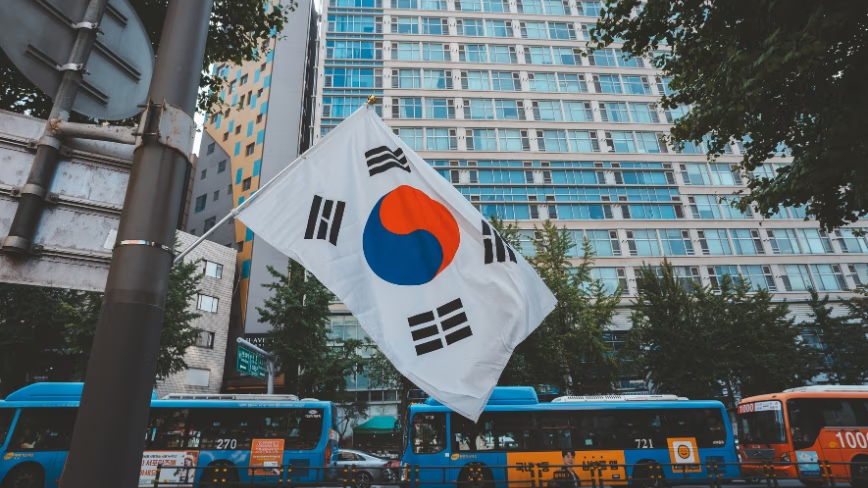

South Korea flag and Street scenery of between Hongdae and Hapjeong station in Seoul, Korea. Credit: 2p2play via Shutterstock.com South Korea expects artificial intelligence, and the chip fabs feeding it, to add between 25 and 30 gigawatts to national electricity demand, which by the country’s own reactor standards is roughly 20 nuclear plants. The government now has to decide whether to build them. The figure comes from Kim Sung-hwan, minister of climate, energy and environment, in an interview with Reuters published on Tuesday.
Kim told the agency that nuclear is “an essential element to consider within the power generation structure of our energy mix”, ahead of an update to the long-term energy roadmap that the government will publish next month and that extends the planning horizon by two years to 2040. What has changed is the construction calendar. Samsung Electronics and SK Hynix are pulling forward fabs that were not meant to exist for another two decades. “Projects originally planned to be built by around 2045 have been significantly accelerated and are now due to be completed by the early 2030s,” Kim told Reuters. Describing work tied to the national chip and AI investment programme, which the Reuters copy sizes at 800tn won.
The scale of the revision is easier to see in the numbers behind the roadmap. According to the Korea JoongAng Daily, the working group drafting the 12th Basic Plan for Long-Term Electricity Supply and Demand now projects peak demand in 2040 at 158.4 to 165GW. In April, the same exercise produced 131.8 to 138.2GW. The gap between the two forecasts, opened in the space of four months, is about 19 APR1400 reactors.
Current peak demand is around 100GW. Almost all of the increase is industrial. Semiconductor manufacturing accounts for 24.3 to 24.6GW of it, against 3.7 to 4GW in April, as the Yongin cluster, four new fabs in the Honam region and expansions at Pyeongtaek and Cheongju were folded in. AI data centres account for a further 11.9GW, nearly triple the earlier estimate.
Even that is a filtered number: companies submitted requests totalling 20.8GW, and planners counted only the 10.8GW in the first phase where the details were firm, setting the rest aside as too uncertain. Not everyone accepts that the filtering worked. Han Ga-hee of the climate group Solutions for Our Climate told the paper that building forecasts on unverified corporate submissions risks overinvestment in generating capacity, a warning with weight in a country whose grid operator is already carrying heavy debt. The counter-argument is about physics rather than politics.
Park Woo-young of the Korea Energy Economics Institute told the JoongAng that among carbon-free sources, nuclear is effectively the only one able to follow the load patterns a grid actually experiences, which is the property a cluster of fabs and data centres running flat out demands. Seoul National University’s Kim Hee-jip put the risk the other way round, warning that a supply shortfall which stopped the country pursuing advanced manufacturing or AI would be a strategic mistake. South Korea runs 26 reactors, supplying about a third of its electricity. Coal provides 29% and gas 27%, leaving renewables at 11%, one of the lowest shares in the OECD.
That mix is the reason the nuclear question is so hard to avoid: offshore wind and the transmission lines to move it take roughly a decade to build, which is the same timescale as a reactor and longer than the fabs now under construction. Public opinion is not the obstacle it once was. A poll by the state-run Korea Energy Information Culture Agency found 79% of 2,000 respondents backed including new nuclear plants in the roadmap. Local opinion is another matter.
In May, a civic group in Ulsan, one of the candidate sites, gathered more than 10,000 signatures against additional reactors on safety grounds. Two large reactors and one small modular reactor have already been approved; the 12th plan decides whether more follow. The commercial pull is explicit. Kim said several US technology companies, Nvidia among them, have expressed interest in building data centres in South Korea specifically because its power supply is dependable.
That is the pitch, and it is also the trap: the reliability that attracts the load is the thing the load puts under strain. Elsewhere, that strain has already shown up on consumer bills. A government proposal is due in October, with the plan finalised by the end of the year.


