

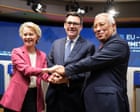

From left, Ursula von der Leyen, Andy Burnham and António Costa at the EU-UK summit in Brussels, 20 November 2026. Photograph: Thierry Monasse/Getty ImagesView image in fullscreenFrom left, Ursula von der Leyen, Andy Burnham and António Costa at the EU-UK summit in Brussels, 20 November 2026. Photograph: Thierry Monasse/Getty ImagesUndoing Brexit is the right thing to attempt – but sadly, I can’t see Andy Burnham pulling it offPaul TaylorBrussels rolled out a warm welcome for the PM but toxic UK politics around rejoining have not gone awayDespite the beaming smiles and the symbolic triple handshake, the summit intended to reset the UK’s tortured relationship with the EU showed just how difficult undoing Brexit will be a decade after Britons voted to leave.To be sure, Brussels laid on a warm welcome. Andy Burnham’s first summit with the heads of the EU institutions felt like the homecoming of an old friend who had been away too long, rather than a meeting to settle some awkward leftovers of a bitter divorce.There was positive progress on food and drink trade, youth mobility and aligning carbon markets.
Yet there was also an inability to resolve relatively simple issues such as the fees young Europeans will pay to study at British universities from 2030, and whether the UK will apply the same tariffs on Chinese electric vehicles as the EU. That is a taste of what lies ahead if a future government, backed by a groundswell of public opinion, decides to apply to rejoin.The fundamental problems of being outside the EU were laid bare: you have to pay for market access and align with rules on which you no longer have a vote. But the issues around seeking renewed membership were also highlighted: the EU always has the upper hand in accession negotiations and the candidate country must adopt its rulebook wholesale – including the free movement of people – and pay into the common budget.Ursula von der Leyen, the European Commission president, was right to say the door is always open but at a price. Burnham is right to argue that Brexit has not benefited the economy, ordinary people or the UK’s standing in the world.
However you do the counterfactual economics, Britain has lost substantial investment, export markets and potential growth, while citizens have faced increasing hassle travelling and living on both sides of the Channel. Young people have also been robbed of opportunities to study and work abroad. As the EU’s divorce negotiator, Michel Barnier, accurately forecast, Brexit has been a lose-lose equation for both sides.However, the summit also illustrated that the toxic British politics around any move to rejoin have not gone away. Once again, the issue would dominate the agenda if the choice were put to a referendum or made the centrepiece of the next general election.Burnham is correct to reopen a national debate on the UK’s long-term relationship with the EU and to put the option of membership back on the table.
As ever, there is a domestic political calculation in his gamble. It helps Labour win back voters lost to the Greens and the Liberal Democrats in this year’s local elections and to mobilise pro-European youth support. He may also reckon that working-class voters lost to Nigel Farage’s Reform UK care more about cost of living issues than they do about Europe.Farage, who built his career on stoking English nationalism and conflating EU membership with uncontrolled immigration, was quick to warn of a betrayal of the British people’s democratic 2016 vote by political elites. The line of the Conservative leader, Kemi Badenoch, that Burnham had been made to accept an unfair deal, in which the UK will have to pay too much for too little return, was a telling indicator of the epic battles over money that lie ahead.Signals from Brussels before the summit suggested the EU would probably not insist that the UK join the euro or the Schengen area of passport-free travel.
But it was equally clear that Margaret Thatcher’s EU budget rebate, won after an epic battle in 1984, would not be returning.skip past newsletter promotionafter newsletter promotionFrom Germany, with love: a letter to the UK | Klaus BrinkbäumerRead moreIt’s not clear that the UK’s political class or its powerful Treasury mandarins have accepted the fundamental pay-to-play logic of either partial access to the EU market or full membership. The widely held denial that Britain needs to pay for market access led to the collapse of negotiations last year to join the EU’s Security Action for Europe programme of soft loans for joint defence projects. Brussels shares responsibility for that failure by pitching an unrealistically high entry fee.While many EU countries would welcome the UK back for geopolitical as well as economic reasons, especially in northern and central Europe, it is less clear that France, which since the presidency of Charles de Gaulle has seen Britain as aligned with US interests, would be so keen. If the hard-right nationalist Marine Le Pen, who applauded Brexit, wins next year’s French presidential election, she has vowed to reduce Paris’s contribution to EU coffers and may want to charge London a high price.The prospect of an EU in which hard-right national populists, less supportive of Ukraine and more friendly in some cases towards Russia, enjoy growing influence may also make rejoining less politically attractive to a UK that is trying to shake off a decade of its own national populism.I would love to see the UK back in the EU, where it always belonged as a European nation.
But I’m not sure I will see it in my lifetime. Paul Taylor is a senior visiting fellow at the European Policy Centre Explore more on these topicsEuropean UnionOpinionBrexitEuropeAndy BurnhamForeign policyLabourFrancecommentShareReuse this content