

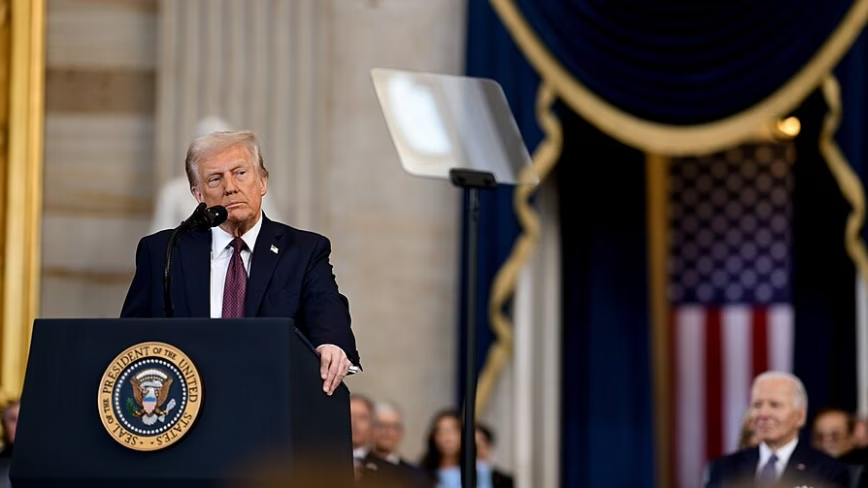

US President Donald Trump Credit: The Trump White House Two days after Donald Trump announced plans for an “AI Force” and an AI czar, the White House has not clarified whether the AI Force would be a military branch, a regulatory agency, or something else. Trump made the announcement on Truth Social on Saturday, rather than through an executive order or official briefing. “He said: For this purpose, I am forming the AI Force, much like I did Space Force, which has been a tremendous SUCCESS, in my First Term. To that end, I will be announcing, in the near future, the AI “Czar” — Only High I.Q. individuals need apply!” Comparing the AI Force to the Space Force sets a high bar that this announcement does not meet, as if comparing apples to pears. Congress created the Space Force by law in the 2020 National Defense Authorization Act, signed in December 2019, and it had its own funding. “AI is the next Industrial Revolution, or the Internet, but will be even larger and more impactful, possibly accounting for as much as 25% of our Country’s GDP.
We are leading China and the rest of the World, and I intend to keep it that way!, continued Donald Trump.” Thus, creating a new military branch requires Congress to both authorize and fund it. There is no bill, executive order, budget, or agency designation for an AI Force of that magnitude, which is the other half of the problem. It is a White House staff role with no Senate confirmation and no statutory authority, and that is precisely why it has no independent power over anything. The position has been vacant since March, when David Sacks stepped down after reaching the 130-day annual limit for special government employees.
He still co-chairs the President’s Council of Advisors on Science and Technology. No replacement has been named, and there is no confirmed shortlist. Adam Kovacevich from the Chamber of Progress said the president “feels pressure to say something” and that the White House has been creating AI policy on the fly. That pressure is also clear in the numbers, as New York Times and Siena polls show that 61% of people oppose AI data centers, including 47% of Republicans.
Trump’s pollster Tony Fabrizio has said that fully supporting them is a losing position. Moreover, the House passed a bill on data center grid costs by a vote of 417 to 3 on September 18. That same weekend, Trump ran a Truth Social poll about renaming artificial intelligence, suggesting Superior, Extreme, and Supreme Intelligence as options. He called the current term inaccurate and awkward, but three days later, neither the poll nor the AI Force has produced any official documents.