

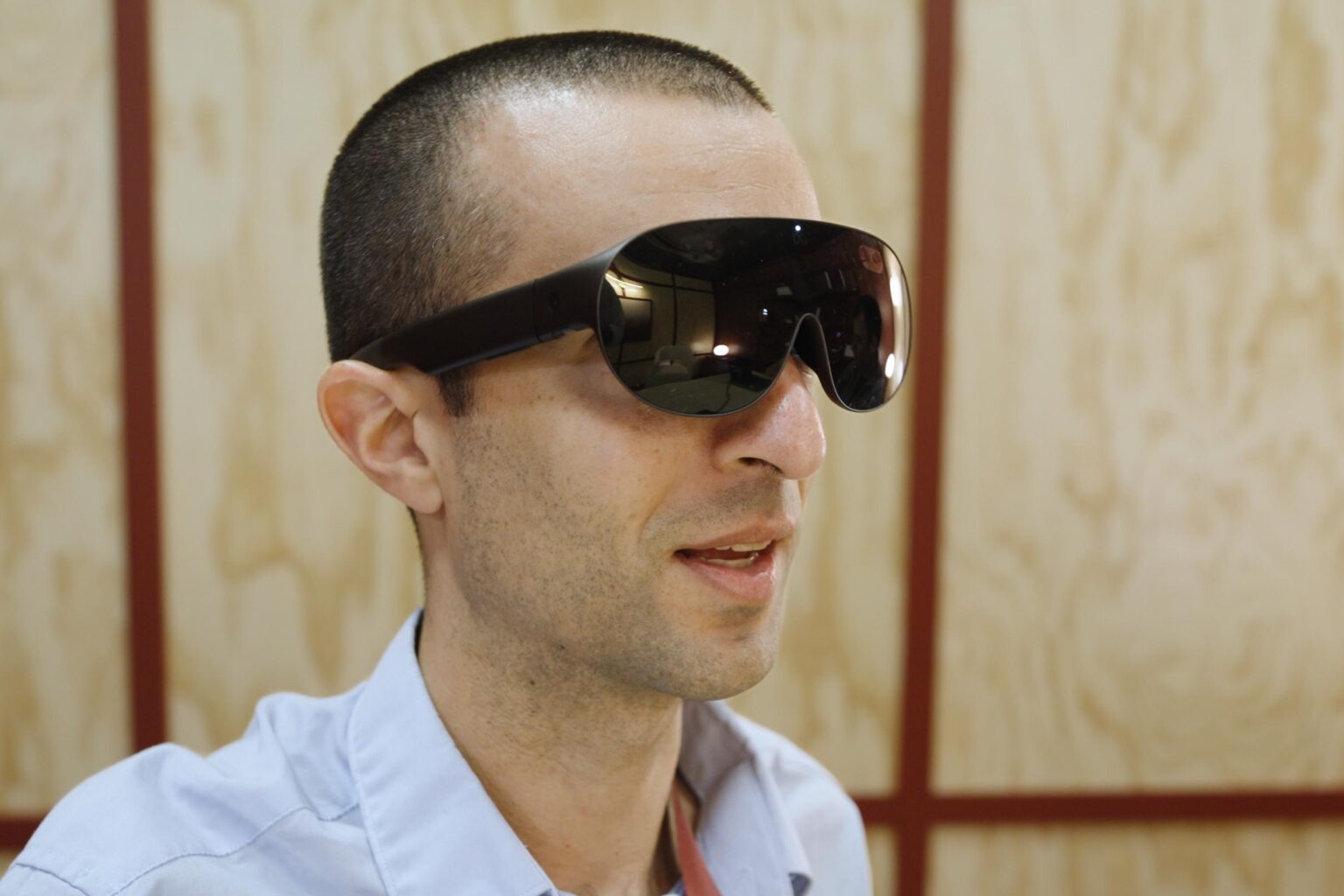

TechNewsMetaMeta’s next VR device isn’t a headset — it’s glassesThe new Meta VR Glasses offer immersive experiences in a shape that’s much easier to actually wear.The new Meta VR Glasses offer immersive experiences in a shape that’s much easier to actually wear.by Jay PetersSep 23, 2026, 11:42 PM UTCShareGiftThe Meta VR Glasses. Photo by Brett Putman / The VergePart OfMeta Connect 2026: The biggest news and announcementssee all updates Jay Peters is a senior reporter covering technology, gaming, and more. He joined The Verge in 2019 after nearly two years at Techmeme.Meta is launching new VR hardware: a pair of glasses. The new Meta VR Glasses sit on your ears like a typical pair of glasses instead of being strapped over your head, but they still have immersive displays for watching movies, playing games, and getting work done. Imagine a pair of hefty black sunglasses with blacked-out lenses on the outside, but the components of a typical VR headset distributed between the device on your head and a computing puck in your pocket.The idea is to give you a way to experience VR in a much lighter and more approachable form factor than Vision Pro or Meta Quest-style headsets.
I got to try the VR Glasses at Meta’s campus this week, and as Meta walked me through some familiar VR demos like watching content, playing a game, and working from multiple screens, I was impressed by how much lighter the whole experience felt. Some of that was about the literal weight, as the glasses come in at just 100g, far less than the Quest 3’s 515g. But there was also something lighter in a more intangible way: the glasses form factor made the headset seem like something I could easily jump in and out of instead of being a whole cumbersome commitment with big head straps. It felt like a lightweight Vision Pro, and is perhaps a better execution of some of what Apple wanted to do with that device.The back of the Meta VR Glasses.
Photo by Brett Putman / The VergeTo keep things light, the VR Glasses’ display and the sensors are all you actually wear on your face. The separate puck connected with a wire contains the guts powering the headset: a Snapdragon Reality Elite processor, 128GB of storage, 12GB of RAM, and the battery, which Meta says will offer up to three hours of media playback, though you can continue using the glasses even while the puck is being charged.The display is what Meta calls a 5K MicroOLED “Infinite Display.” It has 2412 x 2288 pixels per eye at 37 pixels per degree and supports a refresh rate of up to 120Hz. On the front of the glasses are two cameras for color passthrough, letting you see through to the world around you. The headset comes in small and large sizes to offer different options for width, though they cost the same.Here’s the compute puck.
It has a solid clip. Photo by Brett Putman / The VergeYou primarily use your eyes and hand gestures to control the glasses. You just look at elements onscreen to navigate, and the OS will highlight what your eyes are looking at using two pairs of eye-tracking cameras. To select something that’s highlighted, you can pinch your thumb and pointer finger together, and to scroll around, you make a fist and move your thumb around the top of your hand.
It feels similar to the gestures from the Meta Ray-Ban Display, but those require a neural wristband; the VR Glasses instead use six external cameras to follow your hands.Based on my demos, I think the VR Glasses will be best for entertainment because of the big virtual screen. Meta showed me a clip from James Cameron’s Billie Eilish concert film, which was impressive on a huge virtual display, and parts of the most recent NBA Finals, which was filmed on a format called VR180 that provided a 180-degree view of the court. I also got to watch some of Avengers: Endgame in what Meta characterized as a “VR Enhanced Cinema” experience made in partnership with Disney and Industrial Light & Magic. In the entire VR environment around the screen showing the film, there were graphics that thematically lined up with what was actually happening onscreen that also changed as the clip went on; when a huge energy beam appeared at a major moment in the film featuring Thor, I saw one shoot out at the top of the VR environment, too.
Meta says that VR enhanced versions of Avengers: Infinity War and Star Wars: A New Hope will be available when the VR Glasses launch.Photo by Brett Putman / The VergeGaming remains a major use case, too. Meta showed me a new mode for Beat Saber called Flux that supports playing with hands (though it will work with the Quest’s Touch Plus controllers, too). Instead of waving virtual sabers to hit blocks in time with the music, like in the original, Flux tasked me with moving my hands, which were each surrounded by balls of energy connected by pulsing electricity, to break through flying poles and smash targets. It makes sense when you play it, and the one song I played was really enjoyable.
The VR Glasses will have more than 75 games at launch that will support the new hands-first experience (including a VR version of Phoenix Wright: Ace Attorney – Dual Destinies launching in 2027), but they’ll also support the entire current Quest app catalog and can connect to Touch Plus controllers (and Bluetooth controllers).Meta is also pitching this as a way to browse apps and do some work, and I can see the vision. In one demo, I used the glasses to mirror three windows from a nearby laptop. You’ll be able to connect wirelessly to computers or other devices with a USB-C connection, which could be useful if you want more screen real estate for work. My favorite demo from my whole session was actually one about typing.
While using a special version of Instagram made for the VR Glasses, I was prompted to leave a comment on a picture, but I was able to type that comment and navigate the app using a virtual keyboard and trackpad that appeared after I laid my hands flat on the table. To my surprise, the virtual keyboard and trackpad were actually good. Of course, the experience wasn’t as speedy as using a physical keyboard and mouse, but in a pinch for a short message or email, I think it could be quite useful. (I should note it’s not technically new; Meta introduced this for Quest headsets earlier this year, and I haven’t tried it on those devices.)Image: MetaThe glasses cost $1,299.99 and will go on sale in spring 2027. That price puts the VR Glasses between Meta’s $599.99 Quest 3 and a high-end VR headset like Apple’s $3,499 Vision Pro, and I think that’s the right way to think about them.
I don’t think they will transform the landscape of VR, especially when Meta itself has been divesting from VR software and largely moving on from the VR version of Horizon Worlds.Meta is still planning to develop full VR headsets, the company’s VP of product for VR, Angela Chang, tells The Verge. But as tech companies chase the next big hardware category, however, a new form factor is starting to emerge: something that’s more capable than most smart glasses but less overbearing than a full-on VR headset. Google and Xreal are teaming up on XR glasses. Snap’s idea is the augmented reality-focused Specs glasses, and Meta is working on AR glasses too.
The VR Glasses represent another fascinating idea of what a computer on your head can be.Follow topics and authors from this story to see more like this in your personalized homepage feed and to receive email updates.Jay PetersMetaNewsTechVirtual RealityMuse is coming to Meta smart glassesStevie Bonifield3 minutes agoMeta ditches the camera on its newest smart glassesVictoria Song7 minutes agoMeta is making Muse more powerful and will let you video chat with it, tooJay Peters24 minutes agoMost PopulariPhone owners can now submit claims in Apple’s $250 million Siri AI settlementAnthropic’s biolab made a discovery it’s comparing to CrisprActivision is taking over Halo as part of