

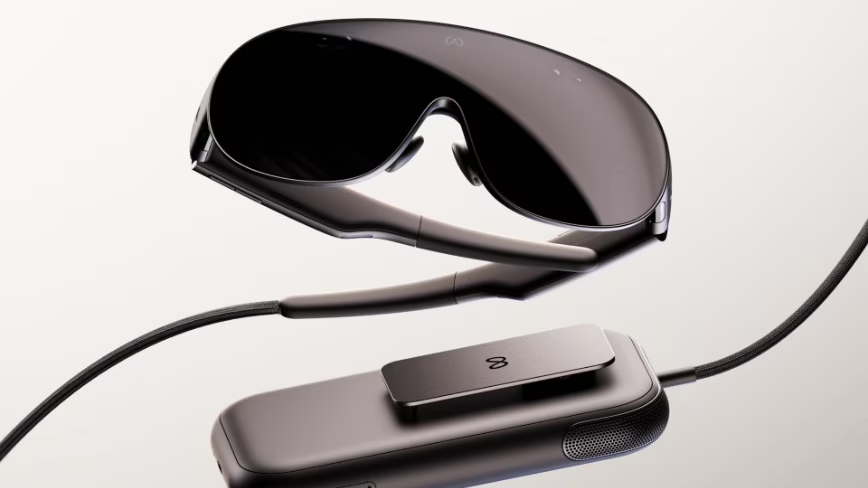

Meta VR Glasses with the compute puck that holds the processor and battery. Credit: Meta Meta will sell VR glasses that weigh about 100 grams for $1,299.99 from spring 2027. It is also turning its AI glasses into over-the-counter hearing aids. Mark Zuckerberg announced both at Meta Connect on Wednesday.
He also showed new Ray-Ban glasses and a keychain device for Muse, Meta’s personal AI agent. He framed the whole line-up around Muse rather than the metaverse. When Meta started building glasses, it expected the metaverse to come first and advanced AI later, he said. “It’s now clear that personal superintelligence will not only come first, it will be much bigger and more important,” Zuckerberg said. VR in a pair of glasses Meta VR Glasses weigh less than a fifth of a Meta Quest 3 headset, Meta says.
A puck connected by an optical tether holds the processor, battery and storage, and clips to a pocket or bag. The glasses use micro-OLED displays and Qualcomm’s new Snapdragon Reality Elite chip. The puck battery lasts up to three hours of video playback. Zuckerberg said Meta has decided to focus a little less on the metaverse and build fewer VR devices.
It will release them only when it has a real breakthrough, and he called the VR Glasses one. Meta says they are the first VR device certified as IMAX Enhanced. Disney+ will stream Marvel films in 3D in select countries from November. HBO Max, Peacock and Paramount+ will offer their 3D catalogues for the first time.
Meta also promises more than 100 immersive live sports events a year, with partners including ESPN and UFC. The glasses double as a computer with several virtual screens, and any flat surface can act as a keyboard. Muse is built into the operating system, so users can talk to it instead of using menus. More than 75 games will work with hand gestures alone at launch.
Glasses as hearing aids A new feature, Hearing Enhancement, turns Meta Glasses into an FDA-cleared, over-the-counter hearing aid, Zuckerberg said. It is meant for perceived mild to moderate hearing loss. Users take a guided hearing test in the app, and the glasses tune amplification to their results. Meta gave no price, saying only that it costs a fraction of a hearing aid.
One in six American adults has some form of hearing loss, Zuckerberg said. The feature comes first to Meta Glasses. Hearing aid makers already sell AI hearing aids, such as Phonak’s EON. More glasses, and Muse everywhere Meta’s first audio-only glasses, Ray-Ban Meta Audio, have no camera, weigh 43 grams and start at $349.
Ray-Ban Meta (Gen 3) starts at $449, with a slimmer design, an hour more battery and six microphones. A Meta Adventurer frame starts at $249, Meta’s cheapest glasses yet. Meta says it will offer more than 100 styles by the end of the year. Meta Ray-Ban Display, its glasses with a built-in screen, are now sold online.
They are expanding to the UK, Canada, France, Italy and Germany. Sales in the three EU countries start on 13 October. Muse gets computer use on the Mac and new shopping partners, Meta’s Alexander Wang said. They include Walmart, Best Buy, Gap, Sephora, Wayfair, Expedia and Instacart.
Zuckerberg said Muse is free for a large number of tokens, and Meta plans to take a small fee on transactions. Meta shares jumped 11% this week as investors bet on Muse. “We believe Muse will make you money,” Zuckerberg said. Reuters reported on Wednesday that Meta is testing human callers behind Muse. Zuckerberg also showed Muse Charm, a keychain device for talking to Muse, which Meta plans to ship in December.