

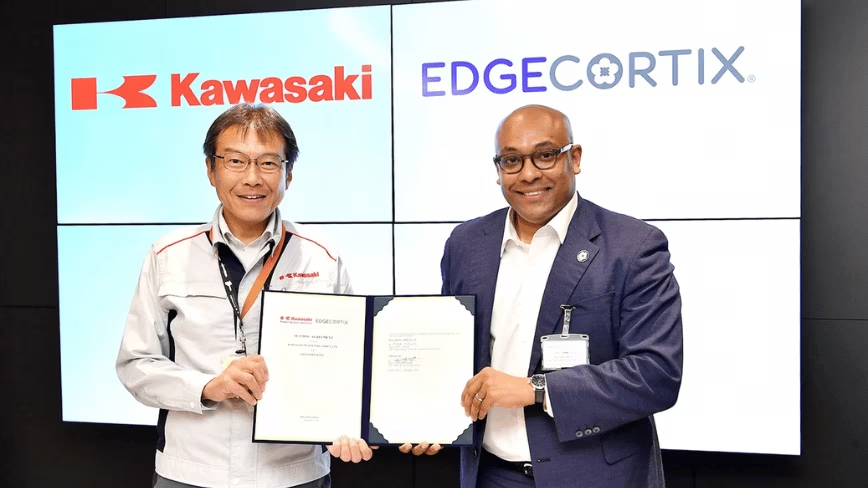

Hideaki Nishimoto, General Manager, Defense & Aerospace Business Division, Kawasaki Heavy Industries and Dr. Sakya Dasgupta, Founder and CEO, EdgeCortix Credit: EdgeCortix Kawasaki Heavy Industries has signed an agreement to put a startup’s AI chips into Japanese aerial defence platforms. The chip company is the interesting part. EdgeCortix, a fabless semiconductor firm based in Kanagawa, announced the deal last week, a teaming agreement running from 2026 to 2028.
Hideaki Nishimoto, who runs Kawasaki’s defence and aerospace division, signed it alongside EdgeCortix founder Sakyasingha Dasgupta. What the deal actually is Read the wording carefully and the size becomes clear. The companies describe “several million U.S. dollars in aggregate program value” across three years. The work is technology development, feasibility studies, system integration and prototype platforms.
Nothing has reached production. No delivery date exists. Set that against Kawasaki. Its aerospace systems division booked ¥613.6bn in revenue last financial year, with an order backlog above ¥1.5tn.
Defence work is nearly a fifth of group revenue. EdgeCortix has raised just over $110m in total. It started in 2019. So the agreement is a rounding error to one party and a milestone to the other.
Both companies say they intend to widen it as technical milestones are met. The part nobody has written The interesting thing about EdgeCortix is not this deal. It is how many countries’ defence programmes one small company is now inside. In June the company said the US Air Force had flown its SAKURA-II accelerator inside a mission system during a large force exercise.
It also said the Pentagon’s Defense Innovation Unit had given it a Success Memorandum. In January, NASA heavy-ion testing validated the same chip as radiation-resilient from low Earth orbit out to cislunar space. In April it took strategic investment from Axiro Semiconductor, a subsidiary of India’s CG Power and Industrial Solutions. And it has taken roughly ¥7bn in Japanese state research money through NEDO, the agency under Japan’s trade ministry, across two awards in 2024 and 2025.
Japan’s defence procurement agency has twice shown the company inside its own booth at the Singapore Airshow. One company. American, Japanese and Indian defence money, running at the same time. What a Success Memorandum is, and is not This is worth explaining properly, because most coverage repeats the phrase as though it were a contract.
It is not. A Success Memorandum awards no money at all. Under the Defense Innovation Unit’s own guidance, a vendor that completes a competitive prototype agreement to its sponsor’s satisfaction receives a memo that lets any federal agency buy that solution later without running a competition. The unit compares it to a sole-source contract.
There is no time limit on using it. Buyers negotiate the price fresh. So the memo is not a sale. It is the permanent removal of an obstacle to a sale, held by a Japanese company.
Non-competitive awards are having a moment in Washington. They were 14.8% of federal contract awards in the first half of this year, against 12.6% a year earlier, and we reported last month on a Pentagon memo directing up to $244m to Palantir without citing any competition exception. That memo cited no legal authority. The DIU route is the opposite case: a documented statutory mechanism, used as designed.
Japan is spending, and changing its rules The context around Kawasaki matters more than the contract value. Japan’s approved defence budget for this financial year is ¥9.04tn, up 3.8%, the twelfth consecutive record and the first time above ¥9tn. The budget names unmanned systems and stand-off missiles as priorities. Under Prime Minister Sanae Takaichi the country reached 2% of GDP two years ahead of schedule, and all three of its core security documents are due for revision in December.
The defence ministry published its first policy on using AI in 2024, naming unmanned assets among seven priority areas. Its procurement agency issued review guidelines for AI in defence research last June. Japan has ruled out lethal autonomous weapons and argues for a global ban. Everything above sits inside that limit.
What Kawasaki actually flies Kawasaki builds the P-1 maritime patrol aircraft and the C-2 transport. It has been flying K-RACER, an unmanned compound helicopter powered by a motorcycle engine, since 2020, and it presents that as a logistics machine rather than a weapon. Its most concrete unmanned move this year was an agreement in June with Airbus Defence and Space to study the Eurodrone for anti-submarine work alongside the P-1. It has also shown a loyal-wingman concept it calls the Collaborative Support Aircraft.
One caution there. That work appears to be company-funded. Japan’s procurement agency has its own collaborative combat aircraft work, and the contracts announced so far went elsewhere. Which makes the EdgeCortix agreement a bet on capability Kawasaki does not yet have a customer for.
Why a Japanese chip and not an American one Here is the question underneath all of it. Nvidia sells edge inference hardware. So does Qualcomm. Kawasaki already works with Nvidia: the two companies opened a joint physical-AI base in San Jose in May, alongside Analog Devices, Microsoft and Fujitsu, and ran Kawasaki’s rideable robot horse through the resulting simulation pipeline.
Defence platforms are a different matter. A system built on American silicon inherits American export decisions about where it can go and who can be sold it. A domestically designed part, funded partly by Japanese state research money, does not. That is a sovereignty argument, and it is the same one Europe keeps making about its own supply chains.
Japan is further along in acting on it. Edge inference is consolidating anyway Buyers are picking off the market EdgeCortix sits in. Analog Devices agreed this week to pay $1.35bn for Alif Semiconductor, which builds processors that run neural networks on the device rather than in a data centre. Helsing is using Rakuten to sell drones into Japan.
China put a 99.2% duty on a deposition gas Japanese fabs sell, this week. A startup with three governments interested in it is not going to stay independent by accident. What to watch Whether the programme moves past prototypes. Both companies have said they intend to expand the scope as milestones are hit, which is the point at which a several-million-dollar study becomes a production contract, or does not.
Whether the chiplets involved are the ones Japanese state money paid to develop. Neither company has said, and it would mean public research funding reaching a defence platform through a company that also holds a Pentagon agreement. And whether anyone in Washington or Tokyo decides that a single supplier sitting in three defence establishments is a problem rather than an achievement.