

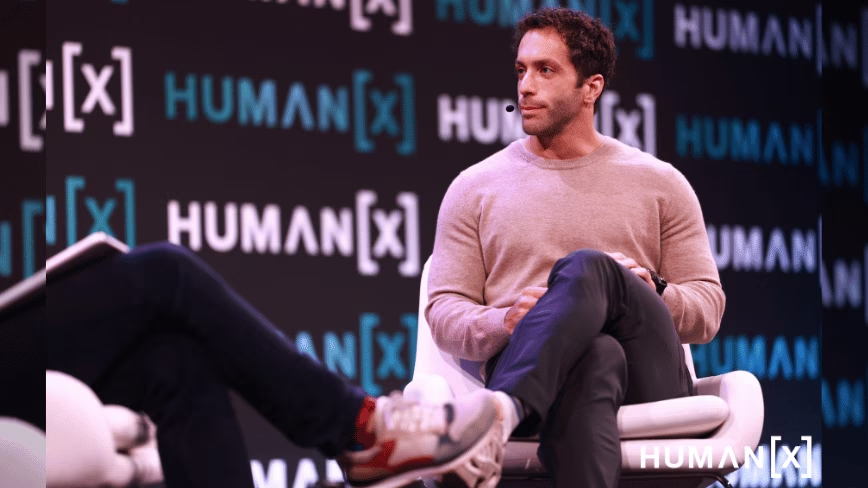

Google DeepMind’s Kareem Ayoub at HumanX in Amsterdam, 23 September 2026. Credit: Sam Pinto / HumanX Companies cannot fully govern AI systems, but they can build a fixed fence around them, Google DeepMind’s Kareem Ayoub said. He pointed to banks in the late 1980s and early 1990s. They put trading algorithms inside fixed rules they could check.
Ayoub, DeepMind’s vice president of AI technical strategy, spoke to Bloomberg’s Tom Mackenzie on Wednesday at HumanX in Amsterdam. He said the safety debate comes down to a tension between exponential capability and linear governance. “You may not be able to fully govern the system itself, but you can build a deterministic governance perimeter around it,” Ayoub said of the banks’ approach. He split the problem into three parts. One is the role AI should play in research and development.
Another is how transparent systems must be. The third is who controls them. Google’s Frontier Safety Framework, which sets capability thresholds and mitigations, is part of the answer, he said. Mackenzie noted that Anthropic’s Dario Amodei wants to pace the frontier.
Demis Hassabis has called for an industry-led regulator modelled on FINRA, the US brokerage watchdog, Mackenzie said. Ayoub said guardrails will need partnerships beyond tech companies. Frontier AI, used for email Ayoub described a gap between what the technology can do and how companies use it. At the frontier, it speeds up drug discovery, translates ancient texts and helps detect gravitational waves.
Inside businesses, the focus often lands on drafting or summarising email, he said. He said the shift from the model to the agent as the product began around the end of 2025. An agent wraps a model in memory, tools and internet access so it can work through long, multi-step tasks. The strongest returns so far are in software engineering, he said.
The best companies he works with share four habits, Ayoub said. They build safe sandboxes quickly instead of waiting for multi-year IT projects. They do not bet against model progress. They measure what they care about.
And their leaders use the tools themselves. “The best businesses ask: will what I’m building be ten times better if the underlying model is ten times better?” he said. Companies fail when they reward staff for hiding their AI use, he said. They also fail when leaders use the tools only superficially. As the cost of intelligence falls, he hopes more spending goes to checking outputs rather than producing more of them.
The mood at DeepMind Mackenzie closed by asking about morale. He cited researchers who have left this year and Hassabis’s move to chairman. Google shifted its AI leadership to Koray Kavukcuoglu in California in August. Ayoub said he had little to add to what has been reported.
He said AGI is Hassabis’s life mission. He recalled Hassabis saying at Google I/O that, looking back, we will probably realise we were in “the foothills of the singularity”. He also pointed to the energy around the Gemini programme, led by Kavukcuoglu. DeepMind launched the DeepMind Institute this month to debate AGI.
Former DeepMind researchers are also building their own companies, including world-model startup Emulate. “The future is no longer a forecasting challenge. It becomes a design problem,” Ayoub said. Also tagged with