

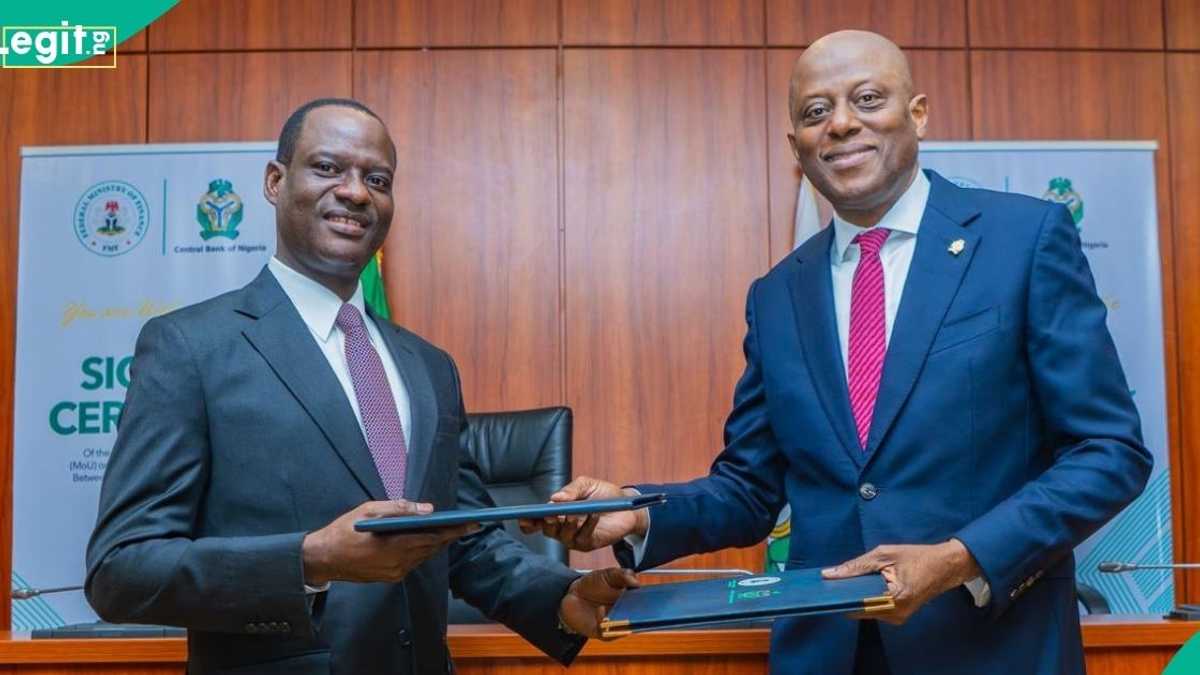

The Ministry of Finance and the Central Bank of Nigeria signed a Memorandum of Understanding covering six policy areasThe agreement targets inflation, fuel price stability, data sharing, and government financing coordination between the two institutionsA Producer Price Index, employment figures, and productivity data are among the new economic statistics the government plans to developPAY ATTENTION: Mark Legit.ng as a preferred source, and our content will appear higher in your Google feed!Legit.ng journalist Dave Ibemere has over a decade of experience in business journalism, with in-depth knowledge of the Nigerian economy, stocks, and general market trends.The Federal Ministry of Finance and the Central Bank of Nigeria have agreed on six key measures aimed at improving coordination between fiscal and monetary authorities and supporting economic stability.The commitments are contained in a Memorandum of Understanding between the two institutions, released on Wednesday, September 23. The agreement is designed to improve data sharing, align economic forecasts and strengthen policy coordination.Finance Ministry and CBN move to align economic forecasts covering inflation, GDP growth, revenue, liquidity and financing needs. Photo: CBN Source: TwitterPAY ATTENTION: From breaking news to viral moments. Follow Legit.ng on Instagram!The six key elements of the agreementThe agreement seeks to ensure that fiscal and monetary policies work together more effectively to support sustainable economic growth and price stability.1.
Aligned macroeconomic assumptionsThe Ministry of Finance and the CBN will work towards more consistent forecasts for inflation, gross domestic product growth, government revenue, liquidity, financing requirements and the external sector.2. Stronger and structured information-sharingThe two institutions will establish clearer mechanisms for sharing information and resolving areas where fiscal and monetary policies could work at cross-purposes.3. Coordinated approach to inflationThe government will pursue disciplined fiscal spending alongside measures aimed at reducing food, energy and logistics costs.The measures include maintaining strategic grain reserves, supporting farmers, investing in rural roads and engaging state governments on road infrastructure.4. Continued fuel price stabilityThe government will seek to maintain stability in fuel prices without reintroducing consumption subsidies that could distort the market.The agreement also recognises tax exemptions and exchange-rate stability as measures that can help moderate pump prices.5.
Expanded and more frequent economic dataThe government plans to expand the availability of economic data, including a Producer Price Index, employment figures and productivity data.The data will be developed in collaboration with the National Bureau of Statistics to support the CBN’s transition towards inflation targeting.Finance Ministry and CBN agree to maintain fuel price stability without reintroducing distortionary consumption subsidies. Photo: CBN Source: Twitter6. Closer coordination of financing and cash managementThe two institutions will strengthen coordination around government financing and cash management to reduce the risk of government borrowing crowding out private-sector credit.The agreement also provides for continued strengthening of fiscal governance institutions, including the Fiscal Responsibility Commission, Bureau of Public Procurement, Nigeria Extractive Industries Transparency Initiative and the Office of the Auditor-General.FG defends petrol price in NigeriaEarlier, Legit.ng reported that the Minister of State for Petroleum Resources (Oil), Heineken Lokpobiri, has defended Nigeria’s petrol deregulation policy, saying the country’s average pump price remains below those of the United States and some African countries.Lokpobiri made the statement on Channels Television’s Politics Today while responding to concerns over the cost of petrol following the removal of fuel subsidies.According to the minister, the average price of petrol in Nigeria was about N1,430 per litre, compared with N1,633 in the US. Source: Legit.ng Dave Ibemere (Senior Business Editor) Dave Ibemere is a senior business editor at Legit.ng.
He is a financial journalist with over a decade of experience in print and online media. He also holds a Master’s degree from the University of Lagos. Fellow, MTN Pan African Media Innovation(2026), Member of the Nigerian Institute of Public Relations and other media think tank groups. He previously worked with The Guardian, BusinessDay, and headed the business desk at Ripples Nigeria.
Email: dave.ibemere@corp.legit.ng. CBN – Central Bank Of Nigeria Ballon d or rankings Australia Nigerian agricultural quarantine service Things girlfriend happy Damon darling