

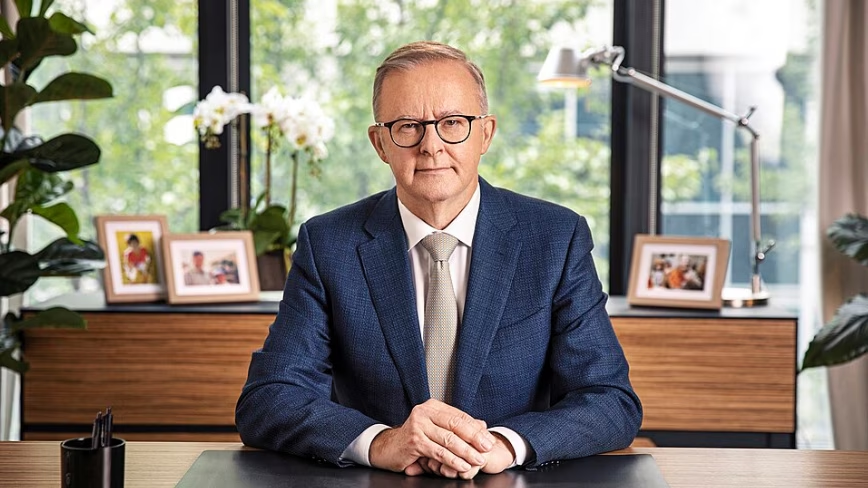

Australian Prime Minister Anthony Albanese Credit: Australian Government Anthony Albanese met Tim Cook at Apple Park on Saturday and said Apple had recognized Australia’s leadership on online safety. It quotes Albanese saying that seeing the new safety features in action “proves that when we draw a line in the sand, tech companies will step up”, and that Apple is showing the industry can compete on safety credentials rather than convenience. “Australia is proud to lead the world with our social media age ban and online safety approach,” said Prime Minister Albanese. The closest thing to a direct characterization came afterward, when Albanese told AAP it had been a proud moment when the head of a company like Apple “recognizes the leadership that Australia has shown”. Recognizing leadership and calling a policy world-leading are not the same statement, and world-leading is Albanese’s own standing phrase for the ban, not one anyone has attributed to Cook. “Tim Cook and Apple are showing that the industry can, and must, compete on safety credentials, not just convenience,” said Prime Minister Albanese. There is also the matter of what Cook now does.
He handed the chief executive role to John Ternus on 1 September and is executive chairman, a position explicitly scoped to policy engagement and regulatory relationships. This is the second time Albanese has publicly cast Cook as an ally of the ban. In June he said Cook had phoned him personally, and that Apple’s revamped child safety features were inspired by the Australian law. Apple’s own framing that week made no mention of Australia at all.
The policy itself has been operating since 10 December 2025 under the Online Safety Amendment (Social Media Minimum Age) Act, covering Facebook, Instagram, Threads, TikTok, Snapchat, YouTube, X, Reddit, Kick and Twitch. Penalties run to A$49.5M, and a bill introduced in June would double that while widening the regulator’s investigative powers. Enforcement has been the weak part. Testers found in July that nine of ten platforms accepted a self-declared age of 16 with no proof.
What has changed for Apple is narrower and more recent. App Store age checks became law in Australia on 9 September, carrying the same A$49.5m exposure. Apple now automatically evaluates a user’s age for Australian App Store downloads, blocks R18+ and simulated-gambling titles, and has provided developers with a Declared Age Range API. Which is the awkward part.
Apple’s long-held position, shared with Google, was that age assurance belongs at the device level rather than in the app store, and it lobbied against the Texas App Store Accountability Act, with Cook calling Governor Greg Abbott directly. Eleven days after complying with app store age checks in Australia, Apple was described in Canberra as the policy’s champion.