

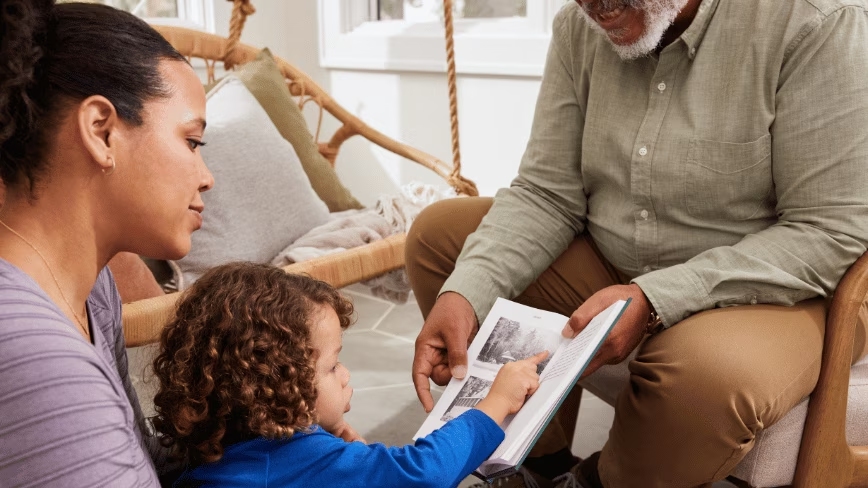

Three generations of a family look through a printed memoir book together Credit: Storyworth There is a particular kind of question that families postpone for years. It is difficult not because the answer is secret, but because the question is too large: Tell me about your life. Faced with it, even a willing storyteller may retreat into generalities. A childhood becomes “happy”.
A marriage was “good”. A migration, a war, a career, a grief, all reduced to a few durable adjectives. The trouble is not necessarily memory. Often, it is form.
From weekly prompts to voice Storyworth began as a family project. Nick Baum recorded his 82-year-old father’s answers; in 2013, he and Krista Baum founded the family-owned company. Its established format is deliberately incremental: a storyteller receives regular questions, responds over time, and eventually turns those responses and photographs into a hardcover book. Rather than demanding an autobiography all at once, the service divides a life into scenes small enough to enter.
The original Storyworth model centered on written responses. A storyteller could answer a weekly prompt by replying to an email or using a Storyworth account. That route remains available. With its newer voice features, however, Storyworth is adding a technological layer between memory and the finished memoir: software can now record, transcribe, prompt and help structure the recollection before it reaches the page.
Story Calls, Magic Interviews and Family Calls The first step in that shift came in 2024 with Story Calls. Storyworth first enabled phone recording in 2013, initially relying on human transcription. In 2024, the company added automated transcription. Today, Story Calls lets a storyteller answer by phone, including on a landline, with the call transcribed word for word.
The distinction matters. A verbatim transcript preserves the loops, digressions and idiosyncratic phrasing of speech, even when the result is less orderly than conventional prose. The storyteller can later revise the text or add photographs, but the initial record begins with the spoken answer rather than a rewritten version of it. In early 2026, Storyworth added two more conversational formats.
Magic Interviews guides a storyteller through a phone conversation and asks follow-up questions. When the call ends, the exchange is shaped into a written narrative and added to the memoir. Family Calls brings another person (a relative or friend) into the conversation, allowing that person to ask questions, contribute memories and help direct the story. The recording preserves both voices, while Storyworth adds a cleaned-up transcript of the conversation to the memoir.
These are small product distinctions, but they produce different kinds of documents. Story Calls privileges fidelity to speech. Magic Interviews privileges structure. Family Calls introduces relationship itself as a source.
A daughter may remember the name of a neighbour her father has omitted. A grandchild may ask why a detail mattered, rather than merely what happened. One person’s recollection can become more specific when another person is present to recognise the gaps. Every question is a frame That does not mean guided conversation produces a deeper or truer memory.
Interviews are never neutral containers. Every question places a frame around the past, and every follow-up makes one path more visible while leaving others unexplored. A polished narrative is also not the same object as a verbatim transcript. The first may be clearer and more readable; the second may preserve more of the speaker’s manner.
Storyworth’s expanded system is interesting partly because it makes those choices visible. Families are not simply deciding what to preserve. They are deciding how much shaping should occur between speech and page. The more consequential shift is that Storyworth is no longer only giving families a place to store finished recollections.
In Story Calls, software transcribes; in Magic Interviews, it asks follow-up questions and helps shape the conversation into a polished narrative; in Family Calls, it preserves a two-person conversation as a cleaned-up transcript. The product is beginning to mediate the act of remembering, not merely preserve its result. Remembering is uneven. People contradict themselves, circle back, pause, misplace dates and discover the meaning of an event halfway through describing it.
A useful family archive cannot eliminate that instability; it can only decide what to do with it. A book with a second record behind it Storyworth’s answer is layered preservation. Stories can be edited and supplemented with photographs after a call. Friends and family with access to the project can listen through a private podcast feed.
In the finished hardcover, a QR code takes authorised readers to the Memoir project page, with stories and available recordings; a downloadable audiobook is included. The result is neither simply a book nor simply an audio archive. It is a printed narrative with a second record behind it: the actual sound of the person speaking. That hybrid model also creates a distinctly digital dependency: the book is physical, but access to the linked recordings is mediated through Storyworth’s platform.
Voice carries information that transcription cannot fully absorb. It contains pace, accent, hesitation and emphasis. It reveals where someone laughs before reaching the end of a sentence, where certainty weakens, where a familiar story still catches in the throat. None of this guarantees intimacy.
A recording can be formal, guarded or repetitive. Yet it preserves the physical event of telling: breath passing through a particular body at a particular moment. Why the telephone works That quality makes the telephone an unexpectedly apt instrument for family history. It is ordinary enough not to feel ceremonial.
It does not require a studio, specialised equipment or, in Storyworth’s system, even a smartphone. The same device used for routine check-ins can become the site where a memory is prompted, questioned, recorded and transferred into a more durable form. The limits of a designed archive There is a tension here that Storyworth cannot entirely resolve. The service turns private recollection into a designed process, and design always influences outcome.
Weekly prompts encourage continuity, but they also divide a life according to the questions selected. Guided interviews can draw out detail, but they may also smooth the disorder from which a person’s way of remembering becomes visible. A family memoir is not the whole life. It is a sequence of chosen entrances.
Still, that limitation belongs to every archive. Photographs exclude what stood outside the frame. Letters preserve what someone was willing to write. Home videos favour occasions when a camera was present.
Storyworth’s voice tools add another kind of partial evidence: not merely what a person remembered, but how the memory emerged in conversation. The phrase “family legacy” is often used as though inheritance were a finished object passed intact from one generation to the next. In practice, it is usually assembled from fragments: a name written on the back of a photograph, an anecdote repeated at dinner, a voicemail no one meant to save. When software joins the act of remembering Storyworth’s newer features show how consumer software can move from storing memory to participating in how it is elicited and organised.
A question is asked, a voice is recorded, a transcript is generated, and a conversation can be reshaped into narrative. Each step adds convenience, but each also adds another layer of design between the remembered event and the archive that survives it. That makes Storyworth interesting beyond the family-memoir market. It points to a larger question for consumer technology: what happens when software becomes an active intermediary in human acts that once seemed too personal to automa


