

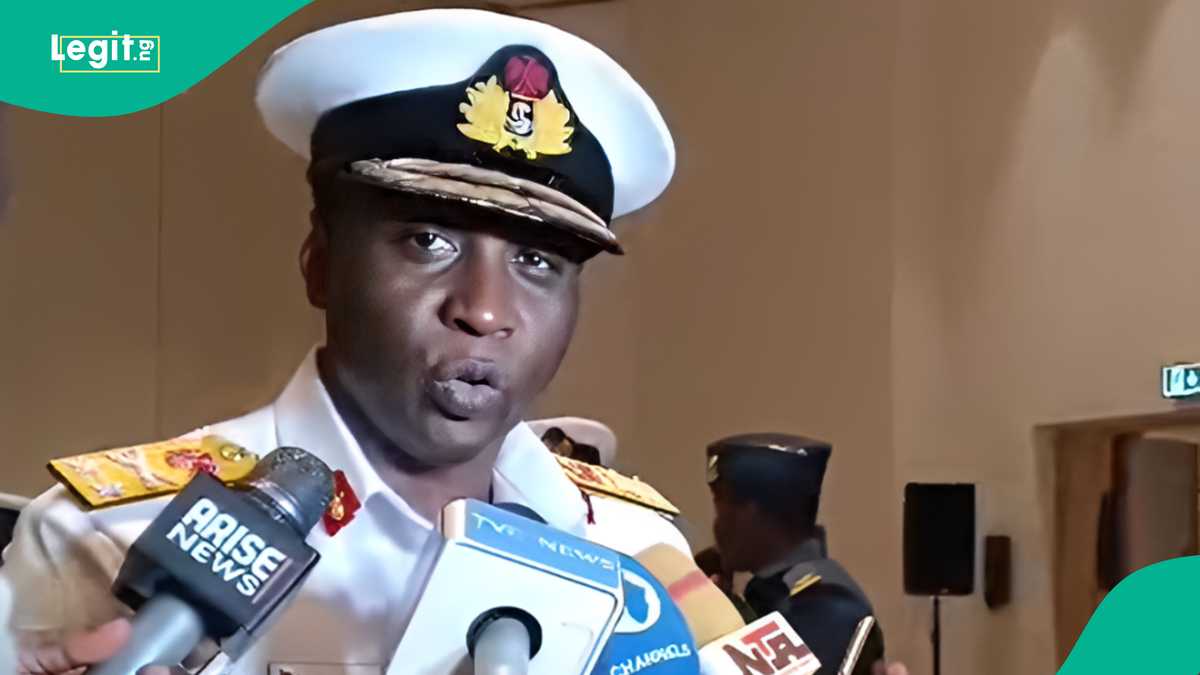

The Nigerian Navy says it will leverage technology and stronger cooperation with security agencies to tackle the growing threat of illicit drug and arms smuggling on Nigeria’s waterwaysThis was disclosed at a four-day transatlantic maritime security symposium in Lagos, attended by naval officers from about 25 countries to discuss the operationalisation of the Yaoundé Code of Conduct and the Combined Maritime Task ForceFlag Officer Commanding Western Naval Command Abubakar Mustapha said the symposium would help strengthen cooperation and coordination among African countries in addressing emerging maritime security threatsPAY ATTENTION: Mark Legit.ng as a preferred source, and our content will appear higher in your Google feed!Lagos, Nigeria – The Nigerian Navy will leverage technology and increased cooperation with other security agencies to tackle the emerging threat of illicit drugs and arms smuggling on the country’s waterways, Abubakar Mustapha, flag officer commanding the Western Naval Command, said on Monday, September 21.Mustapha, who represented Idi Abbas, the chief of naval staff, spoke at a four-day maritime security symposium in Lagos.Flag Officer Commanding Western Naval Command Abubakar Mustapha speaks at a maritime security symposium in Lagos. Source: OriginalSpeaking with journalists at the event, Mustapha said Nigeria had maintained a zero-piracy level but was facing a growing threat from the smuggling of narcotics and firearms through the central Gulf of Guinea.He said the Navy was strengthening its ability to identify and track vessels of interest, particularly those arriving from South America, while working with other agencies to conduct checks and forensic searches.PAY ATTENTION: From breaking news to viral moments. Follow Legit.ng on Instagram!According to him, the recent flag-off of the Combined Maritime Task Force (CMTF) by President Bola Tinubu showed that Africans are committed to coordinating the continent’s maritime security threats.”The more we leverage technology and the more we cooperate, the more we operationalise the CMTF, the more we will be able to discontinue the smuggling of illicit drugs and illicit-related drugs into our continent in general,” Mustapha said.Navy steps up vessel screeningMustapha said maritime security was a layered issue requiring the involvement of several agencies, with the Navy and the CMTF playing a key role in identifying vessels that may be linked to illicit activities.He said Nigeria had established a framework for screening vessels arriving from South America, with security agencies sharing information and conducting checks on vessels considered suspicious.”Sometimes you can’t be 100% sure, but once these vessels still go to the port, we go further and search them,” he said.Mustapha cited the recent destruction of more than 560 kg of illicit drugs by the Navy in collaboration with the National Drug Law Enforcement Agency (NDLEA) and other agencies as evidence of the security agencies’ efforts to intercept narcotics entering Nigeria.He said stronger cooperation, technology and the full operationalisation of the CMTF would improve the country’s ability to disrupt maritime smuggling networks.Maritime Security Symposium: 25 Countries Meet in LagosMustapha spoke in Lagos at a four-day transatlantic maritime security symposium attended by naval officers from about 25 countries.The symposium, which began on Monday, was convened by the Africa Centre for Strategic Studies and the William Perry Centre for Hemispheric Defence Studies to discuss the operationalisation of the Yaoundé Code of Conduct.Naval representatives from participating countries include those from Cote d’Ivoire, the Democratic Republic of Congo, Equatorial Guinea, Gabon, Angola, Argentina, Brazil, Benin, Cabo Verde, Cameroon, and Colombia.The Yaoundé Code of Conduct, adopted in 2013, provides a regional framework for West and Central African countries to combat piracy, armed robbery against ships and other illegal maritime activities in the Gulf of Guinea.Mustapha said participants would also discuss protocols for operationalising the Yaoundé agreement and the CMTF.Emerging threat beyond piracyThe symposium comes as maritime security officials increasingly focus on threats beyond piracy, including drug trafficking, arms smuggling and other forms of transnational organised crime.Francis Edosa, an air vice marshal representing Olufemi Oluyede, chief of defence staff, said criminals often exploit the maritime domain for piracy, arms and narcotics trafficking.He said maritime threats did not respect national boundaries and therefore required cooperation among naval forces.Assis Malaquias, academic dean at the Africa Centre for Strategic Studies, said the symposium was aimed at bringing naval forces together to develop an architecture for implementing the Yaoundé Code of Conduct.He said participants would examine barriers to implementing the agreement and develop practical solutions to address them.Naval officers and maritime security officials from about 25 countries attend a symposium in Lagos. Source: UGCNNPCL Sees CMTF Helping Curb Crude Oil TheftAlso speaking at the symposium, Dahiru Sani Gwarzo, chief interface officer at NNPC Ltd, said the petroleum company viewed the CMTF as an important mechanism for protecting Nigeria’s oil and gas resources in the Gulf of Guinea.Gwarzo said NNPC Ltd was a major stakeholder in maritime security because of the criminal activities affecting vessels and crude oil operations in Nigerian waters.”We see all the vessels carrying away our crude,” Gwarzo said, adding that crude oil theft had been a persistent problem in previous years.He said information sharing between the CMTF and other government security and intelligence agencies had helped address the problem.”With the full operationalisation of CMTF, we believe that this crude oil theft will amount to zero, will come down to zero,” Gwarzo said.He said the formalisation of the CMTF by President Tinubu during the Nigerian Navy’s 70th anniversary celebrations in June provided an opportunity for NNPC Ltd to better protect its resources and address security gaps in Nigerian waters.”The CMTF is a big, big help for us in NNPC,” he said.
Source: Legit.ng Nurudeen Lawal (Head of Politics and Current Affairs Desk) Nurudeen Lawal is an AFP-certified journalist with a wealth of experience spanning over 8 years. He received his B/Arts degree in Literature in English from OAU. Lawal is the Head of the Politics/CA Desk at Legit.ng. He previously worked at Lantern Books and Saraba Magazine.
Lawal was named the Political Desk Head of the Year (Nigeria Media Nite-Out Award 2023). Lawal is a member of the Oxford Climate Journalism Network. He is also a certified fact-checker (Dubawa fellowship, 2020). Contact him at lawal.nurudeen@corp.legit.ng or +2348054399455.
Lagos StateNigerian Navy Uk student visa Gary owens Gabbie carter Sadia sanusi Molly noblitt